The Road to Driewegen
MWC 2026 · Driewegen, Netherlands
Inside the MWC 2026
Invitation Process
369
invitations sent
170
athletes confirmed
4
invitation rounds
With the 2026 Masters World Championship just months away in Driewegen, Netherlands, this is a behind-the-scenes look at one of the most consequential steps in building that event: the athlete invitation process. Over four rounds, SAI reached out to the world's top masters Highland Games athletes — and the numbers tell a compelling story about the global depth of our sport and what it takes to assemble a world-class field.
How the process works
SAI's invitation system is built on transparency. Athletes are ranked according to published qualification criteria and invited in order of their standing within each class. To build that list, a dedicated team of five volunteers spent over 250 hours compiling scores from more than a dozen websites spanning competitions around the world. Making this the most comprehensive rankings list ever assembled for this championship.
Each round carries a defined response window. Round 1 athletes had 7 days to confirm or decline, while all subsequent rounds operated on a tighter 5-day window.
When an athlete declines or does not respond within their window, that spot opens to the next qualified competitor on the list, ensuring every available roster position ultimately goes to someone who genuinely wants to compete in Driewegen. We made sure the correct people were invited by checking and double-checking at the end of each round to confirm the accuracy of the completed round and ensure the next round was equally precise.
Round-by-round breakdown
Invitations sent and response outcomes by round
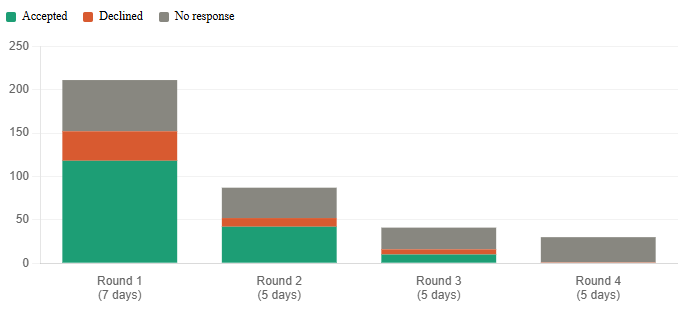
Round 1 was the highest-volume round by every measure. With 212 invitations sent over a full 7-day window, it produced 118 confirmations — nearly 70% of the total confirmed field. Rounds 2 and 3 filled gaps left by non-responses and declines, with Round 2 leading the way, adding 42 more athletes to the roster.
Round 4 marked a shift in approach. The team audited the full list of athletes who had not responded, cross-referenced it against classes that were either full or had no remaining eligible athletes to invite, and identified 10 of the 20 classes that met those criteria. For each class still open, invitations were issued from the top of the non responded athlete list downward, targeting enough athletes to fill all available slots.
Round 4 ultimately produced the starkest picture: 30 invitations, zero acceptances, and 29 non-responses.
Acceptance rate by round
Share of invited athletes who accepted, vs. overall response rate
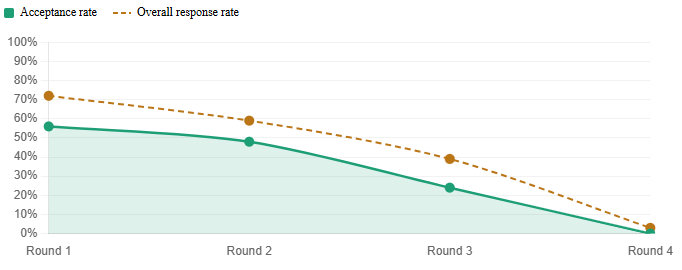
The acceptance rate chart confirms what experience suggests: the athletes who rank highest in their class are also the most committed to competing at the world level. Round 1's 56% acceptance rate set the tone; by Round 3 that figure had dropped to 24%, and Round 4 yielded no new athletes at all.
The gap between acceptance rate and overall response rate is equally telling — many athletes formally acknowledged their invitation rather than simply going silent, a small but meaningful signal of professionalism across the masters community.
The final picture
Overall outcomes across all 369 invitations sent
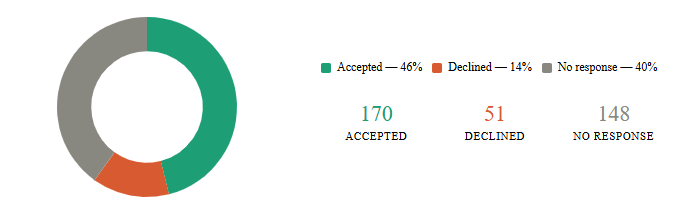
Across all four rounds, 170 athletes confirmed their places — 46% of the 369 invitations sent. A further 51 formally declined, and 148 invitations went unanswered by the close of their respective windows.
That 170-athlete confirmed field is a testament to the global reach of Masters Highland Games competition — competitors traveling from North America, Europe, Australia, and beyond to Driewegen this September. The process built to reach that number sets a new standard for SAI championship administration.
"We look forward to welcoming 170 athletes — and their supporters — to Driewegen this September for what promises to be an extraordinary Masters World Championship."